
This past Tuesday, I came across a post:
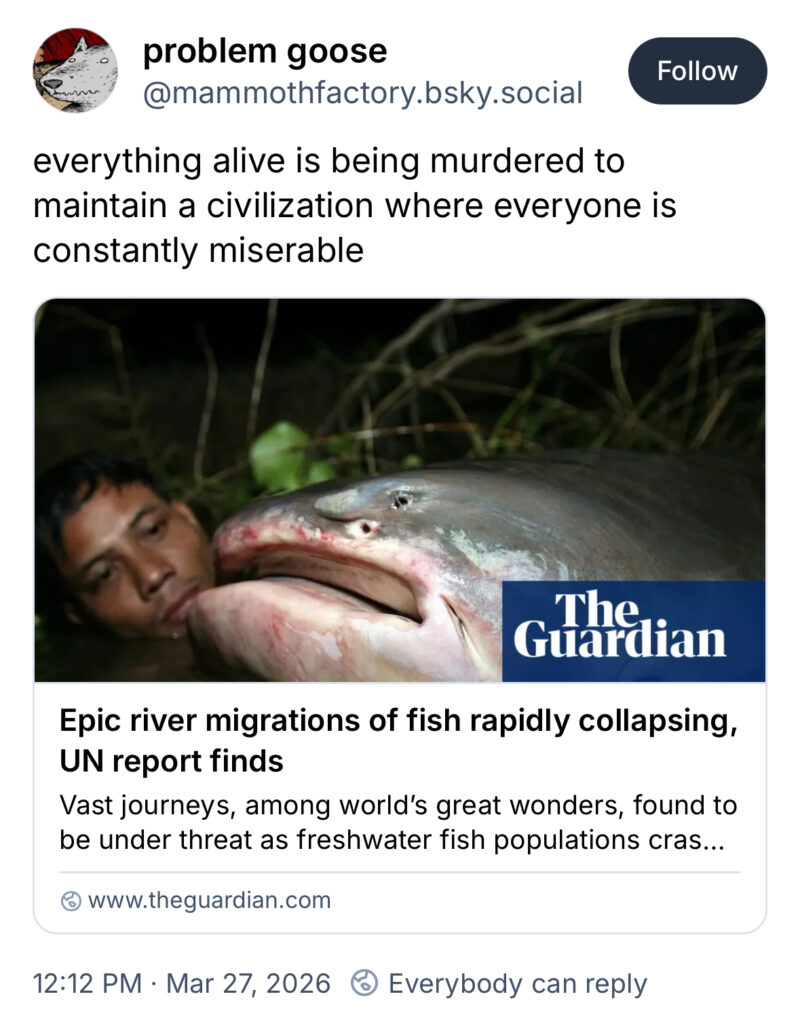
Not going to lie, I am a bit of a doomer these days, and the Guardian never disappoints – but the numbers here are particularly striking. I remember hearing about insect die-offs a couple of years ago, and feeling shocked at the just-less-than-half number of insects under threat of extinction. According to this article, however, freshwater fish populations have declined by more than 80% since 1970.
I was a (mostly) sentient being in 1970, and I attempted to fish while I was at camp in the Adirondacks (the largest protected park in the US – more than 6 million acres and almost 1/5 of New York State – containing some 1,200 miles of rivers). It was an embarrassing state of affairs to have to admit that I never caught a fish, despite the fact that it was possible to see them, feel them, everywhere.
Today, evidently, I might not feel such shame. At least not because I can’t catch fish.
That more than three-quarters of the freshwater fish population has disappeared in my lifetime is appalling – both because it happened, and because it isn’t really “news”.
Did you know this?
So, I learned that on Tuesday (maybe you just learned it today). Then, on Thursday, I attended the Design for Freedom conference, and heard a related story that spun my depression into . . . something less depressed.
I am no better a painter than I am a fisherman, so paints/pigments for painting are not something that I really think about too much. I love a good story about Rothko and his disappearing paintings (due to the villainous Lithol Red), or the fact that Cochineal bugs (known for producing a “perfect red” pigment) were almost as valuable as silver in Colonial times; but, I don’t really focus too much on color, because it is usually in a very subjective context.
When I see that there is a panel discussion involving artists, the painter is usually the one that I expect to connect with through their “message”, whatever that might be. I do not expect to have a painter jar my perspectives about the possibilities in the materials universe.
John Sabraw did just that.
If you have sixteen minutes, there are few things that will convey a sense that “It IS possible to do good things” than this film – don’t let the title fool you.

One of the key issues that I have been . . . observing? researching? . . . in the design universe has been Scale: scale of resource utilization, scale of production, scale of markets. I always asked my students “how many of these do you expect/want to produce?”, because the answer to that question will impact how that thing is designed, what it is made of, and how it will be made. Get those things right, and get your market analysis right, and you are – literally – in business.
Another focus of my teaching and my research is the oft-maligned Triple Bottom Line concept of People, Planet, and Profit. While it seems that many reverse the order, or simply do away with the first two all together, it’s not all that hard to simply THINK about these things in the course of conducting business.
What John and his colleagues have done is remarkable on all fronts: they saw an environmental problem, saw an opportunity to use the waste material causing that problem as a raw material, and built a business that sustains itself while solving the problem.
That their product is a raw material in the production of Beauty is poetic perfection.